Better Data

Jean Case, our CEO, issued a simple clarion call in the Stanford Social Innovation Review last month: #ShareYourData.
The time is now. The impact investing field has grown leaps and bounds since the Global Impact Investment Network first started tracking the growth of the field in 2010. Networks like Toniic and The ImPact have brought together a range of interested investors who want to learn more about allocating for impact. Even dedicated impact funds are attracting LPs with diverse motivations. We’ve witnessed large-scale asset managers jump into the space, alongside a rise in specialty managers that are building businesses around servicing impact.
With a surge in activity, the Case Foundation’s commitment to transparency laid out in SSIR is particularly critical. We believe that to truly scale impact investing, we need to continue to engage in discourse around the challenges and solutions we are encountering in our everyday work.
With ImpactAlpha, the Case Foundation is kicking off a four-part series alongside Acumen, Bridges Fund Management, and ImpactSpace (ImpactAlpha’s open impact database) to share concrete lessons learned around tackling pervasive challenges across the impact investing ecosystem. Each of our stories digs in on the complexities of changing culture, practice, expectations and habits across a range of actors.
The Case Foundation’s work in impact investing has focused critically on myth busting. We have consistently conveyed the importance of pushing back on misconceptions around concessionary returns, the nascent size of the industry and fear of cannibalization of philanthropy. Across our work, we’ve seen that these myths create barriers to engagement, ensuring that the most significant problems we face across the globe remain under-invested or ignored.
Changing the culture around transparency and disclosure
Since a public commitment from the stage of the Milken Global Conference, we’ve been working to build a data-driven visualization of impact investing transactions to-date. Our hope is that by visualizing and bringing the connections between actors to life, we can foster a better understanding of the enormous potential of the impact investing movement. Such transparency around historical data is key to encouraging more participation in the impact investing space and tapping into the vast amounts of capital and interest that are not yet part of the movement.
For many skeptical investors and institutions, pointing to concrete examples of what impact investments look like, who’s involved, and the size and type of capital deployed, is a necessary part of myth-busting.
Without clarity around where capital flows and to whom, we can only get so far in claiming that there’s a real market here. Information vacuums prohibit those within the sector from learning and growing, as well as those currently outside of this ecosystem from joining in.
To see this change, we need to facilitate a deeper and more inherent system-wide change — a change in our discomfort around transparency and disclosure. This is particularly true when it comes to basic information (like where a company operates or the sector an investor is interested in).
If the impact investing space wants to attract more capital and investors, it will need to tackle this issue head on. And because no single investor has the power to change the culture of transparency in the field by itself, we believe there needs to be systemic effort to catalyze this change.
Our Solution: The Impact Investing Network Map
By building the Impact Investing Network Map, we aim to tackle this problem by creating the infrastructure to showcase data that will educate and activate more investors. It will also highlight where data gaps are, and where the sector needs to improve disclosure practices.
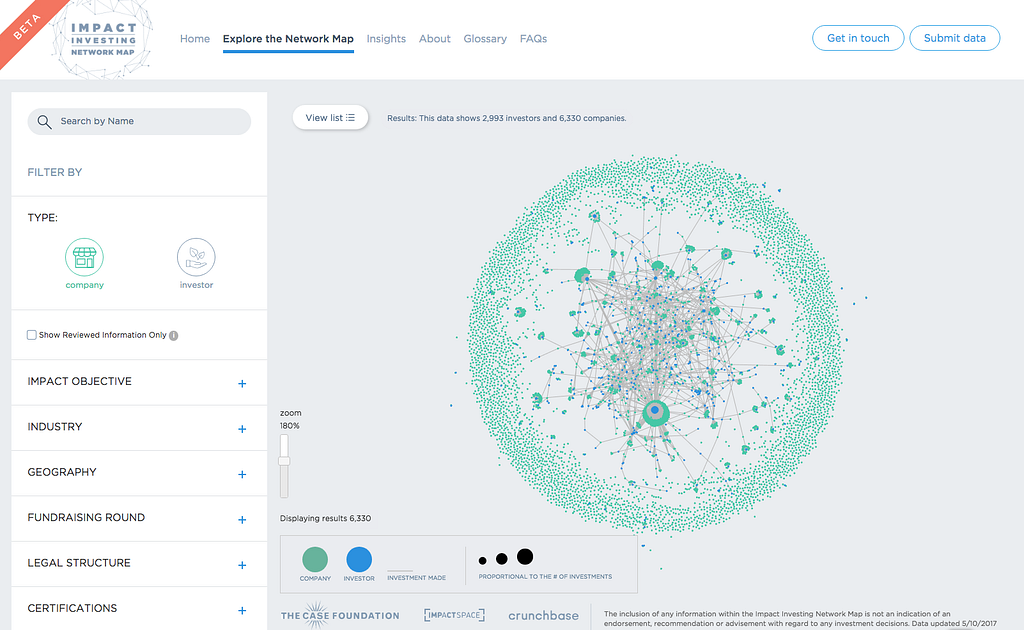
The Impact Investing Network Map is an easy-to-use tool that provides current and potential investors, intermediaries and social entrepreneurs with a snapshot of the impact investing market, searchable by geography, asset class and impact objective. In its Beta version, the Network Map visualizes the relationships between investors and companies, based on publicly available information from our data partners, ImpactSpace and Crunchbase.
Though self-reported, publicly available data has limitations, we’re looking for transparency to become the norm. As more and more data is made available, it will paint a clearer picture of the overall state of the field, including gaps and potential areas of growth. The more investors that submit their data directly to ImpactSpace, the more comprehensive a picture of the impact investing space the Network Map provides.
The opportunity for growth is endless.
To reach that critical mass that will allow us to showcase these Insights, we need more actors to share their data. The Impact Investing Network Map features a range of information for each company or investor. Organizations submitting data can include critical profile data, like where a company is located, or the sector an investor focuses on.
Financial data around fundraising is also an important component of the tool. We recognize that there is a spectrum of reporting that actors will opt in to, and we continue to encourage responsible disclosure. That’s not an obstacle to organizations demonstrating their commitment to transparency. By providing simple but critical information on where we work or the impact we’re trying to have, we can know more about the scope of this ecosystem.
Transparency is key to growing the impact investing space, and we believe the Network Map is a valuable tool towards this end. But creating the Network Map is just the first step. We are asking leaders in the impact investing movement to share their available data and help us to better map the ecosystem.
Join us as a Beta tester by signing up at casefoundation.org/networkmap. Or share your data directly at impactspace.com.
Culture of transparency: Putting impact investing on the map was originally published in ImpactAlpha on Medium, where people are continuing the conversation by highlighting and responding to this story.
By Rehana Nathoo, Vice President of Social Innovation, the Case Foundation
This post was originally published on ImpactAlpha.com
 Visit the Invest With Values - Resource Directory to access leading investor information, opportunities, organizations, events, groups and tools.