The Brief
Dreamer economics, big biz needs small biz, driving financial inclusion, Asia’s sustainable food boom
Sept. 5, 2017
Greetings, ImpactAlpha readers!
#TalkingPoints: Dreamers
How Dreamers boost the American economy. The Trump administration’s plan to cancel the program that allows about 800,000 U.S. immigrants who arrived as children to stay and work must have been about politics, because it sure wasn’t about economics. The economic case will become clearer in the six months before the scheduled end of Deferred Action for Childhood Arrivals, or DACA. Here’s a start:
- Job creation. Dreamers’ roughly $30 billion a year in earnings “has a job-creating ripple effect on the economy.” (Cato Institute)
- Wage growth. “Immigration just doesn’t hurt native-born workers very much…Some studies even find that immigration raises native-born wages, by prompting locals to go back to school and improve their skills.” (Noah Smith/Bloomberg)
- Human capital. Nine out of 10 DACA recipients have found work and are working for U.S. companies. (Center for American Progress / FWD.US)
- Fountain of youth. Dreamers are young, which means they “mitigate the economic problems caused by an aging population.” (Paul Krugman/NYTimes)
- Economic driver. Ending DACA would cause a loss of $460.3 billion in GDP, cut contributions to Medicare and Social Security by $24.6 billion over a decade and cost employers $6.3 billion in employee turnover costs. (Center for American Progress / FWD.US)
- Tech-savvy. Brad Smith, president of Microsoft, told NPR, if the government moves to deport Microsoft’s Dreamers, “it’s going to have to go through us to get that person.” Tech executives were near-unanimous in condemning Trump’s plans.
How Dreamers boost the American economy
#Featured: Open Mic
How big companies are turning to small businesses to expand their reach — and impact. Growing numbers of multinational corporations have recognized that working with local small and growing businesses — commercial ventures with five to 250 employees and significant potential for growth — can boost their bottom line and improve the lives of people in less-developed economies. Unilever, General Mills, Cargill, Hershey, EY, Microsoft, SAB Miller, Marriott and other corporations are shoring up supply chains, expanding distribution, entering new markets and finding new customers in partnership with small and growing business. Because of the mismatch between the scale and complexity of large corporations and small, local and social businesses, intermediaries who understand the challenges can increase the chances of success.
Read, “How big companies are turning to small businesses to expand their reach — and their impact,” by Randall Kempner and Stephanie Buck of the Aspen Network of Development Entrepreneurs:
How big companies are turning to small businesses to expand their reach — and their impact
#Dealflow: Follow the Money
AgDevCo invests $6.5 million in farming ventures in Zambia and Mozambique. The non-profit agribusiness investor, which is backed by the U.K. development agency DFID, invested $5 million in Katito Farming Enterprises, a new commercial farming operation in the Mbala region of Northern Zambia. AgDevCo’s investment in Katito is its second in Zambia. The farm is part of an effort to give local smallholder farmers access to regional export markets, and to create over 170 new local jobs. The farm fits with efforts from the Zambian government to “shift the mainstay of the economy from mining to agriculture,” Zambia’s Daily Mail reports. AgDevCo’s investment calls for improved security of land tenure for communities around the farm. Katito has also secured $7 million from a local investor. In Mozambique, AgDevCo is backing banana exporter Citrum SA with $1.5 million to rehabilitate a banana plantation. AgDevCo is working with Nika, a group of Mozambican investors, to support Citrum in increasing the banana plantation’s yields and sales. The plantation will employ 140 people locally and is focused on hiring and promoting women.
Turner Impact Capital slates $100 million for affordable healthcare facilities. The Turner Healthcare Facilities Fund will invest in and developaffordable community health centers in underserved urban areas in the U.S. The fund is focused on lower-cost preventative care provided by primary care clinics and ambulatory surgery centers. It also targets the growing need for affordable senior care, as the U.S.’s over-65 population grows from 40 million today to 73 million by 2030. Unlike other Turner funds, there’s as yet no celebrity face for this new fund. The fund’s first investments will be new facilities in Florida for Dedicated Senior Medical Centers, a primary and specialty care provider, which is opening its first center in a former 13,000 square-foot retail space in St. Petersburg, Fla.
IntelleGrow launches $31 million social enterprise debt fund. IntelleGrow, the early-stage venture investing arm of Mumbai-based Aavishkaar-Intellecap Group, will provide working capital to fill a gap in social-venture financing in India. “Companies require long-term working capital and long-term debt [to] finance their equipment, plant and machinery,” IntelleGrow’s Akbar Khan told e27. “A debt fund will be more helpful because it is more attuned to their pay-out structures.” Startups’ cashflow will be a key investment criterion. IntelleGrow launched in 2012, with backing from the Shell Foundation. The company is raising $100 million in debt and equity to finance social startups in India. It has backed more than 180 startups in agriculture, healthcare, sanitation, and other social sectors.
See all of ImpactAlpha’s recent #dealflow.
#Signals: Ahead of the Curve
How Kenya, Brazil, Mexico, Colombia, South Africa and Uganda are driving financial inclusion. National policymakers are recognizing the small and big benefits of more people having access to and using finance services such as mobile money, credit and insurance. Financial inclusion boosts local economic activity, gives customers the tools to plan for the future and boosts household welfare. National-level commitments to financial inclusion landed the six countries at the top of a list of 26 countries ranked by the Brookings Institution. Bringing more people into the financial fold could boost emerging market economies by $3.7 trillion by 2025, according to McKinsey Global Institute. Investors also see an opportunity. Funding of fintech startups has topped $40 billion (compound annual growth of 41%) over the last four years. Cybersecurity and consumer protection issues are key to maintaining and building confidence, according to Brooking’s Financial and Digital Inclusion Project.
Engineering impact for 21st century challenges. Agtech. Greentech. Fintech. Edtech. Tech is all the rage in conversations about how to advance environmental and social agendas like the Paris climate agreement and the 2030 Sustainable Development Goals. Engineers behind the technology welcome the challenge. The American Society of Mechanical Engineers and Engineering for Change are hosting “Impact.Engineered” next month in New York to amplify the engineering voice in the impact discussion. Key questions: how to encourage the flow of technological innovation — in both directions — between advanced and emerging economies; and how to engineer increasingly dense yet climate-resilient cities and feed billions more people by 2050. ImpactAlpha is proud to be a sponsor of the October 18 event at the Center for Social Innovation. Get a 20% discount with the code “IMPACTALPHA.” Register here.
#2030: Long-termism
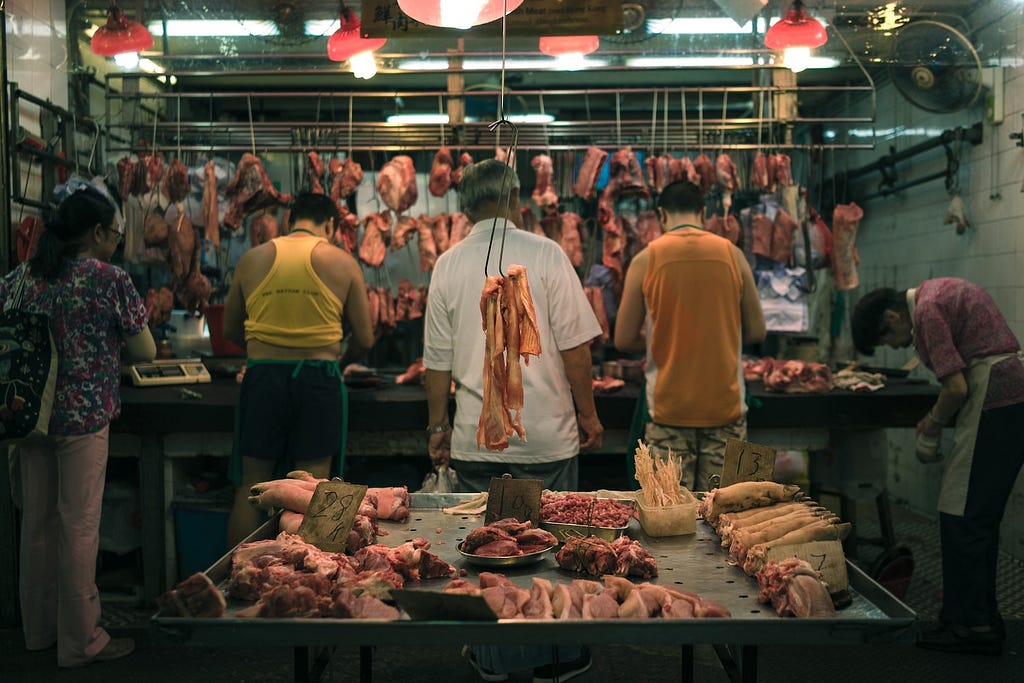
Asia’s boom in sustainable food. Chinese regulators shuttered a Shanghai meat factory several years ago after reports it had supplied out-of-date meat to McDonald’s and Yum Brands, KFC’s parent company. The scandal cut the market value of the two fast-food companies by $10.8 billion and highlighted risks in Asia’s protein supply chains. It also spurred investors to find opportunities to invest in sustainable food products and practices.
Asia’s growing middle class is eating more meat, boosting demand as much as 20% by 2025. That is exposing sustainability risks in Asia’s meat, seafood and dairy industries, according to the investor initiative Farm Animal Investment Risk and Return (FAIRR). “Investors have a big appetite for Asia’s animal protein sector,” says Jeremy Coller, CIO of Coller Capital and an author of Factory Farming in Asia: Assessing Investment Risk. “But growth is driven by a boom in factory farming, which tends to mean more emissions and more epidemics, abuse of antibiotics and abuse of labour, all risks to returns.”
Southeast Asia, for example, has more than 175,000 deaths each year due to foodborne illnesses, the most in the world. In South Korea, avian flu pandemics in 2016 and 2017 required the culling of more than one-fifth of the poultry industry. Last year, 14 Myanmar migrants workers filed suit against a Thai chicken farm, seeking $1.4 million for violating workers’ rights.
One investor’s risk is another’s opportunity. “Investors will assess the ability of companies in the meat supply chain to position themselves ahead of these risks,” says Jaideep Panwar of APG Asset Management Asia, an arm of the Dutch pension giant. Filipino food giant Monde Nissin in 2015 acquired UK meat substitute producer Quorn for $812 million. Monde Nissin predicts Asia’s meat alternative industry will reach $5.2 billion by 2020. Healthy Living Biotechnology, a Taiwanese start-up, allows consumers to trace eggs from chickens raised without antibiotics with a QR code. From 2012 to 2016 in Southeast Asia, vegan product launches jumped 140% and new vegetarian products more than quadrupled.
Onward! Please send any news and comments to TheBrief@impactalpha.com.
Dreamer economics, big biz needs small biz, driving financial inclusion, Asia’s sustainable food… was originally published in ImpactAlpha on Medium, where people are continuing the conversation by highlighting and responding to this story.
This post was originally published on ImpactAlpha.com
 Visit the Invest With Values - Resource Directory to access leading investor information, opportunities, organizations, events, groups and tools.