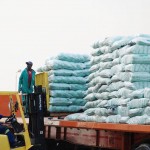
There is an old Portuguese saying that you cannot expect the sun to shine on the threshing floor while it rains in the turnip fields.
Some would apply the saying to impact investing to argue investments can’t simultaneously deliver market-rate returns and measurable social impact. The harder investors pursue social goals in sectors where commercial capital is absent, they argue, the more likely financial returns will suffer.
But just as there has been innovation in threshing, new investment approaches offer ways to offer risk-adjusted market rates of returns to bring commercial capital into these difficult markets. Blended finance models that mix public, philanthropic and private capital can compensate investors for risk-taking in backing solutions that generate high social returns.
AgDevCo invests in the agriculture sector in Sub-Saharan Africa, focusing on early-stage businesses that are starved of capital. To date we have backed 45 SME businesses and committed $60m. There’s little doubt that investing in agriculture can deliver a high social pay-off.
But what level of financial returns should we expect? There are data points from outside the impact investing community. The development finance institutions, or DFIs, have been investing in emerging markets including agriculture for fifty years or more (maybe impact investing is not as cutting edge as some like to think).
• The UK’s CDC specialised in agriculture investments during the period 1950 – 2000. A recent research paper concluded that only a third of investments generated financial returns above an “acceptable commercial level” of 12 percent. However, in many cases where CDC lost money, the business it supported went on to become sustainable operations which created significant positive social impact and delivered commercial returns for later-stage investors.
• The IFC has published returns data on more than 300 exists from SME businesses (across all sectors). Investments above $2 million delivered good financial returns and an acceptable level of write-offs. However, investments below $2 million were generally not profitable and write-offs reached 20-30 percent.
• Members of the European Development Finance Institutions (EDFI), an association of bilateral DFIs, report that only 5 percent of new investments made in 2014 were in the agriculture sector, whereas agriculture makes up at least 25 percent of GDP in most developing countries.
We draw two tentative conclusions. Firstly, in developing countries agriculture does not appear to offer financial returns that are as attractive and/ or requires more patience than other sectors such as financial services, infrastructure and manufacturing (otherwise DFIs would be more heavily weighted towards agriculture).
Secondly, for investments below one or two million dollars, financial returns are likely to be lower, if not negative, and the risks of business failure are significantly higher. However, as companies mature they should be able to generate better financial returns, so graduation to commercial capital is a real possibility.
AgDevCo’s experience to date is more or less in line with this. With an average investment size of below $1.5m, we are expecting to recover our invested capital and make a modest contribution to our running costs. As we expand and balance out the portfolio with some larger investments, we anticipate moving towards profitability. In the meantime, part of our operating costs will continue to need grant funding.
What does this mean for the prospects of attracting more commercial capital into the agriculture sector? The need in developing countries is huge, perhaps $83 billion annually per the FAO.
The high risk-low return characteristics of agriculture in developing countries is compounded by the fact that most opportunities are at the smaller end of the spectrum where returns can be swamped by transaction costs. It is unlikely the sector is going to attract large volumes of commercial capital any time soon.
A few pioneering active blended finance investment funds target agricultural development today, and the concept is accelerating. The World Economic Forum is backing the approach with a new blended finance toolkit. The Canadian government is behind a new marketplace, Convergence, that seeks to bring together private and public funders to blend their capital, creating more financially attractive, high-quality deals. Nick O’Donohoe of Big Society Capital, a pioneer of impact investing in the UK, has recently been appointed as senior adviser on blended finance at the Bill and Melinda Gates Foundation.
My Portuguese colleague tells me only her grandparents’ generation still use the threshing floor proverb. In the modern economy, blended finance can take advantage of both the shining sun and the falling rain to allocate capital to the places where most of the world’s food gets grown.
Disclosure
Chris Isaac is a founding Director of AgDevCo, a social impact investor in the African agriculture sector. He is speaking on blended finance approaches at the Convergence “Blended Finance for Agriculture” conference in partnership with Citi and UNEP in London on Friday 20th November 2015.
A version of this post originally appeared on LinkedIn.
Photo credit: The International Maize and Wheat Improvement Center
This post was originally published on ImpactAlpha.com
 Visit the Invest With Values - Resource Directory to access leading investor information, opportunities, organizations, events, groups and tools.